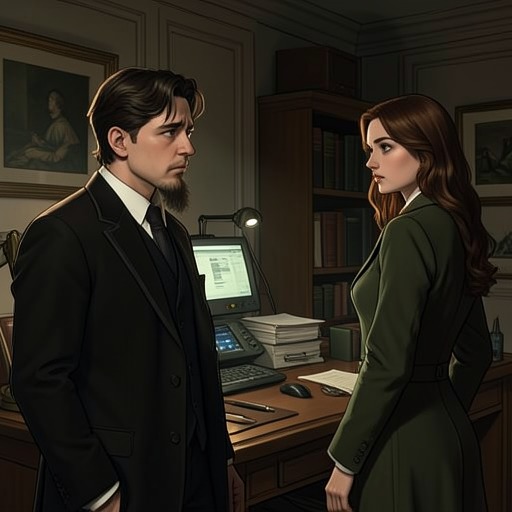
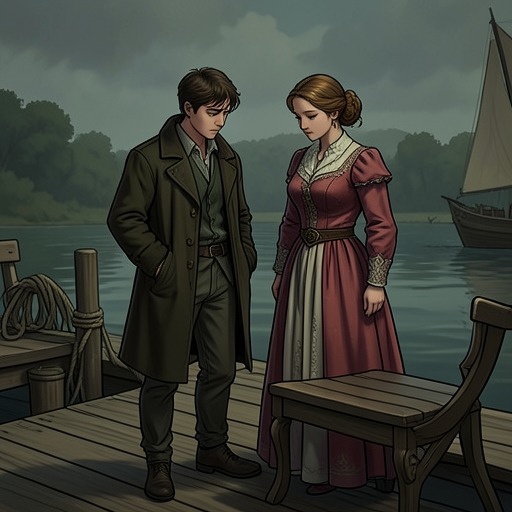
Pip and Estella’s relationship
Great ExpectationsPip and Estella’s relationship reaches its final form not through marriage or the recovery of their youthful hopes, but through a meeting among the ruins of Satis House. Once bound together by Pip’s unrequited love and Estella’s emotional distance, they encounter one another again after years apart, recognize what each has lost and learned, and agree to remain friends. The scene turns the place of their first meeting into a setting for reconciliation, while leaving their future together deliberately unclaimed.
The Past and the Return to Satis House
For years, Pip’s attachment to Estella has shaped his hopes and his sense of himself. When Biddy asks whether he has forgotten her, Pip says that he has forgotten nothing that ever held a foremost place in his life, but describes the dream he once pursued as having passed away. His words are not the whole truth: even as he speaks, he secretly intends to revisit the site of the old house that evening, alone, for Estella’s sake. The discrepancy makes the final meeting a return he has not openly admitted, even to a trusted old friend.
Pip has heard that Estella led an unhappy life, that her husband treated her with great cruelty, and that she had become separated from him. He has also heard that the husband died in an accident following his ill-treatment of a horse. The death had occurred about two years earlier; Pip does not know whether Estella has since married again. These reports establish the hard circumstances that have intervened between the woman he once idealized and the figure he is about to meet. They also leave her present life partly unknown, so the reunion begins without any promise that the old relationship can simply resume.
The old house and brewery no longer stand. A rough fence encloses the cleared ground; ivy has taken root again among low mounds of ruin. In the cold, silvery mist of the afternoon, Pip can still trace the former positions of the house, brewery, gate, and casks. The landscape holds the memory of their first meeting even after its buildings have disappeared. When Pip sees a solitary figure in the garden, the setting brings the past into the present without restoring it: what remains is a remembered place, altered by time and loss.
Recognition and Changed Affections
The woman is moving toward Pip, but stops as he approaches. She seems about to turn away, then lets him come nearer; surprised, she says his name. Pip recognizes her as Estella. She remarks that she has changed greatly and wonders that he knows her. Her admission immediately puts change at the center of the encounter: the reunion is not a return to their earlier selves, but a meeting between people altered by separate lives.
Pip sees that the freshness of Estella’s beauty has faded, while its majesty and charm remain. What is new to him is not simply her appearance but the softened, saddened light in the eyes that had once seemed proud, and the friendly touch of the hand that had once seemed insensible. The contrast gives physical expression to the distance between their former dynamic and their present encounter. Estella’s changed manner is tangible before either has explained it; the old coldness has yielded to a warmth Pip had not previously felt from her.
They sit together on a bench near the ruins. Pip observes that it is strange to meet again after so many years in the place where they first met, and asks whether she often returns. Estella replies that she has never been there since. The site has therefore remained largely outside her intervening life, even as it has been charged with meaning for Pip. Their brief exchange establishes both a shared point of origin and an asymmetry in how each has carried the past.
Memory, Regret, and Suffering
Estella tells Pip that she has often thought of him, and especially often of late. She recalls a long, hard period when she kept away from the memory of what she had thrown away because she had been ignorant of its worth. Now, she says, her duty does not conflict with admitting that memory, and she has given it a place in her heart. Her account changes the emotional balance between them: the woman who once appeared untouched by Pip’s devotion now recognizes that she failed to value what he offered.
Pip answers that Estella has always held her place in his heart. His reply confirms the persistence of his affection, but the scene does not use it to demand that she return it in romantic form. Instead, their exchange makes room for two different histories: Pip has preserved his feeling, while Estella has come to understand its value through loss and reflection. The relationship’s renewed intimacy rests on honest acknowledgment rather than the restoration of the former dream.
Estella says that she had not expected to take leave of Pip while taking leave of this place, and that she is glad to do so. Pip is troubled by the prospect of parting, which he has always found painful, and remembers their last separation as a source of continuing sorrow. Estella answers by recalling his words at that earlier parting: he had asked God to bless and forgive her. She now believes he will say them again, because suffering has taught her to understand what his heart had once been. She describes herself as bent and broken, but hopes that she has been broken into a better shape. The language presents suffering not as a guarantee of happiness, but as the painful education through which Estella has become capable of recognizing another person’s feeling.
Reconciliation and the Meaning of Their Ending
Estella asks Pip to be considerate and good to her as he had been before, and to tell her they are friends. Pip rises with her, bends over her as she stands, and answers that they are friends. This is the decisive change in their relationship: affection, once entangled with humiliation and unreturned desire, becomes an explicitly mutual bond. The assurance does not erase the past; Estella’s request invokes the kindness Pip had shown even when she could not understand it, while his answer accepts her changed self without requiring a romantic promise.
Estella adds that they will continue as friends apart. Their words acknowledge a limit as well as a renewal: they choose an enduring connection, but do not claim a shared domestic future or reunite as lovers. Pip takes her hand, and they leave the ruined place together. Their joined gesture gives the friendship a physical sign of reciprocity, contrasting with the once-insensible hand whose friendly touch had surprised him.
As they walk away, Pip recalls the morning mists rising when he first left the forge and sees the evening mists rising now. The repeated image links the final encounter to his departure from his earlier life, but the conclusion gives the image a changed emotional charge. In the tranquil light he sees no shadow of another parting from Estella. This does not mean they will remain together; Estella has explicitly said they will be friends apart. Rather, the ending recasts separation: instead of an unresolved wound, it becomes compatible with a lasting friendship and a more generous understanding of the past.